Lavender Fields in Provence: Where, When & How to See Them
Where the lavender fields of Provence are, when they bloom, lavandin vs true lavender, and how to visit Valensole, Sault and the Luberon responsibly.
The lavender fields of Provence are the postcard image of the South of France: endless rows of purple combed across rolling plateaus, humming with bees under a hard blue sky. But “Provence” is a big region, the bloom is short and weather-dependent, and the fields are working farmland — not a park. This guide covers exactly where the lavender grows, when it actually blooms, the difference between the lavender and lavandin you’ll photograph, and how to visit responsibly.
Where the lavender fields are in Provence
There is no single “lavender field.” The famous purple rows are spread across three main areas, each at a different elevation — which, as you’ll see, is the key to timing your trip.
The Valensole plateau (the iconic one)
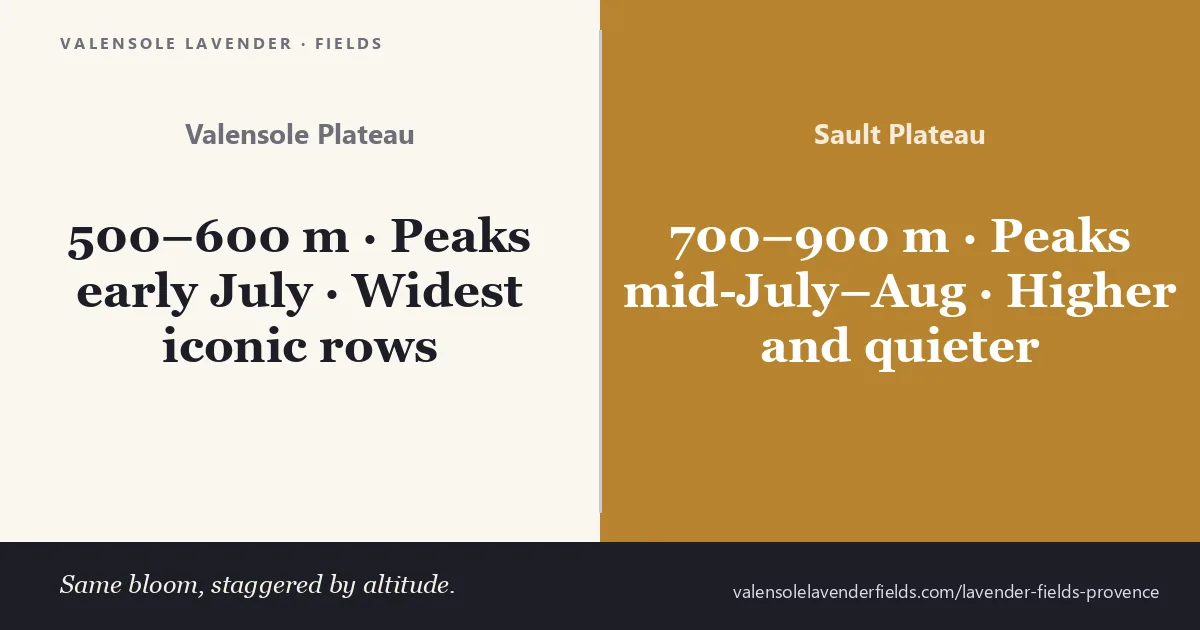
The Plateau de Valensole, in the Alpes-de-Haute-Provence department, is the image most people picture: vast, gently rolling, planted edge to edge with lavandin in long uniform rows. It sits at roughly 500–600 metres of altitude and is the most famous and most visited of the three areas — the one the tour buses head for. It’s about an hour from Aix-en-Provence and around 90 minutes from Marseille. It also sits right next to the Gorges du Verdon, the turquoise Lac de Sainte-Croix, and the clifftop village of Moustiers-Sainte-Marie, so it’s easy to combine the fields with dramatic scenery in one day.
The Sault plateau (higher, later, quieter)
Sault, in the Vaucluse at the foot of Mont Ventoux, sits much higher — around 700–900 metres. That altitude makes it noticeably cooler, more rural, and far less crowded than Valensole. Crucially, the higher you go, the later the bloom: Sault peaks weeks after Valensole, which makes it the place to go if you’re travelling in late July or early August.
The Luberon (Sénanque, Gordes & Coustellet)
The Luberon, west toward Avignon, is lower and warmer, so its lavender tends to colour up first — roughly a week before Valensole. Its signature image is the Abbaye de Sénanque, a 12th-century Cistercian abbey near Gordes that is still home to a small community of monks, with a small lavender field in front of it. The abbey itself gets very busy. Nearby Coustellet (in the commune of Cabrières-d’Avignon) is home to the Musée de la Lavande, a good rainy-hour or shoulder-season stop to understand how the oil is made.
| Area | Elevation | Bloom peak | Crowds | Best for |
|---|---|---|---|---|
| Valensole | around 500–600 m | first two weeks of July | High — the famous one | The classic infinity rows; combining with Verdon |
| Sault | around 700–900 m | mid-July to early August | Low — rural and quiet | Late-summer travel; escaping the crowds |
| Luberon (Sénanque) | lower / warmer | late June, ≈ a week before Valensole | Busy at the abbey | The abbey shot; pairing with hilltop villages |
When do the lavender fields bloom?
Across Provence the season runs from roughly mid-June to mid-August, but no single field is purple for that whole stretch — the window moves with elevation and the weather. As a rule of thumb:
- Luberon: colours up first, peaking around late June.
- Valensole: peaks in the first two weeks of July, with harvest usually beginning around July 15.
- Sault: peaks mid-July to early August, thanks to its altitude.
The single most important caveat: the window shifts year to year. A hot, dry spring can pull the peak forward by a week or more, and once a field is harvested the purple is gone for the season — replaced by grey-green stubble. Always check recent local field reports for the current year before you lock in a date, and if you can only travel in August, aim higher (Sault) where later-blooming fields may still be standing. For the full elevation-by-elevation calendar, see our guide on when lavender blooms in Provence.
Lavandin vs. true lavender — why the rows look the way they do
This trips up almost every first-time visitor. The famous uniform Valensole stripes are mostly lavandin (Lavandula x intermedia), a sterile hybrid grown for high essential-oil yield. Its bushes are large and rounded, carrying several flower spikes per stem, and it thrives on the lower, warmer plateaus — which is exactly why it’s planted in those long, even, photogenic rows.
True (fine) lavender (Lavandula angustifolia) is a different plant: smaller, with a single spike per stem, and it grows higher up — rarely below about 600 metres. It yields less oil but a finer fragrance and is what’s prized for perfume. Both are “lavender”; lavandin is simply the workhorse that gives Valensole its signature look. Neither is better to photograph — but knowing the difference explains why a high field at Sault looks wispier than the dense corduroy of Valensole.
How to visit the fields responsibly
The lavender itself is free and open — there’s no entrance fee and no “tickets.” But these are private, working farms, and a little etiquette keeps them beautiful:
- Don’t pick the lavender or walk into the rows. The plants are a crop; trampling and picking damage them and the harvest. Photograph from the edges and the tracks.
- There is no public transport to the fields. No train and no village bus drops you in the lavender, which is why nearly everyone arrives by car or on a guided day tour.
- Mind the bees. A blooming field hums with honeybees. They’re focused on the flowers, not on you — move slowly and keep small children close.
- Park only in designated areas so you don’t block farm access, carry out your litter, and don’t fly drones over working fields without permission.
For the self-drive route numbers, parking and best times of day, see how to visit the Valensole lavender fields.
Photography & the iconic spots
The fields you’ve seen online — deep saturated purple, long shadows, warm light — are an early-morning and evening phenomenon. Midday on the plateau is hot, harshly lit, and crowded. Go at golden hour: the rows are nearly empty, the light is soft, and the bees have settled.
On the Valensole plateau, the most photographed roads are the D8 (Valensole toward Puimoisson) and the D56 (toward Moustiers), known for the lone almond trees standing in a sea of purple and the old stone huts (bories) at the field edges. The D6 toward Manosque is the classic “lavender road” lined with distillery viewpoints. To shoot the best light without driving in the dark, a dedicated sunset and photo tour puts you in the right field at the right hour.
The five ways to actually experience it
Because there’s no public transport and the timing is unforgiving, most visitors book a guided day trip. The options break down by your base and the experience you want:
- From Aix-en-Provence — the closest major city, about an hour away, with the widest choice of departures.
- From Marseille — full-day trips from the coast.
- Sunset & photo tours — timed for golden hour and near-empty fields.
- Lavender + Verdon Gorge combo — pairs the fields with the canyon, the lake and Moustiers.
- Private tours & farm visits — your own pace, plus the distillation story behind the oil.
Still deciding which plateau to aim for? Our honest Valensole vs. Sault vs. Luberon comparison weighs bloom timing, crowds and access so you can match the field to your travel dates.
Whichever you choose, the lavender season is short — once you’ve settled on your window, check availability on a guided tour rather than gambling on a self-drive to an already-harvested field.
See the Provence Lavender Without the Logistics
The fields are free and open, but reaching the right one at the right light is the hard part. Guided day tours handle the route, the timing, and a working-farm visit — most with free cancellation.
Browse Lavender Tours from Aix